
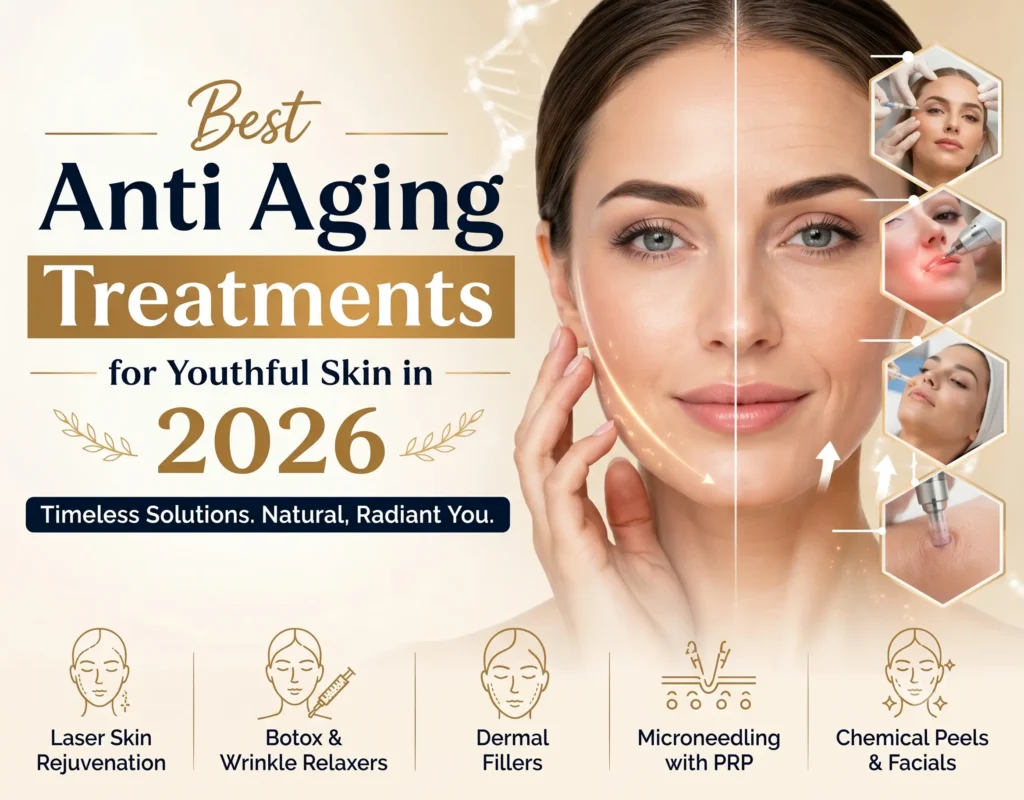
Ageing is a natural process, but modern dermatology now offers many safe and effective ways to manage visible signs of ageing. In 2026, anti-ageing care is moving beyond simply treating wrinkles. The focus is increasingly on improving skin quality, maintaining natural facial structure, supporting collagen, and achieving results that still look like you.
However, there is no single treatment that is the best anti-ageing treatment in 2026 for everyone. The right option depends on your age, skin type, concerns, facial structure, lifestyle, and treatment goals.
If you are looking for personalised anti-ageing advice, Dr. Monika Kucheria can assess your skin and recommend treatments according to your individual needs.
Why Is Anti-Ageing Treatment Different in 2026?
Anti-ageing treatments have changed significantly over the years. Earlier, many people focused mainly on reducing wrinkles or adding facial volume. Today, patients often want a more natural result that improves the overall quality of the skin without making the face look over-treated.
As a result, modern treatment plans may combine skincare, injectables, lasers, collagen-stimulating procedures, and lifestyle changes.
The aim is not necessarily to make someone look much younger. Instead, the goal is to make the skin look healthier, smoother, firmer, and more refreshed.
1. Sunscreen: The Most Important Anti-Ageing Step
Before discussing advanced treatments, it is important to understand that daily sun protection remains the foundation of anti-ageing skincare.
Regular UV exposure contributes to pigmentation, fine lines, wrinkles, uneven skin tone, and loss of skin elasticity. Therefore, consistent broad-spectrum sunscreen should remain part of your daily routine.
Dermatologists commonly recommend broad-spectrum SPF 30 or higher, with reapplication when you spend significant time outdoors. :contentReference[oaicite:1]{index=1}
Professional treatments can improve existing signs of ageing, but protecting the skin from further UV damage helps maintain those results.
2. Retinoids and Anti-Ageing Skincare
Retinoids remain one of the most established topical options for improving signs of photoageing. They can support skin renewal and collagen production and may help improve fine lines, uneven texture, and pigmentation.
However, stronger retinoids can cause dryness, peeling, or irritation, especially when used incorrectly. Therefore, they should be introduced gradually and selected according to your skin type and tolerance.
A simple routine is often better than using many active ingredients at the same time. In fact, dermatologists recommend first establishing consistent sunscreen and moisturiser use before adding targeted anti-ageing products. :contentReference[oaicite:2]{index=2}
3. Botox and Other Botulinum Toxin Treatments
Botulinum toxin treatments are among the most established non-surgical options for expression-related wrinkles.
They work by temporarily reducing the activity of specific muscles that create dynamic lines. As a result, they can soften concerns such as forehead lines, frown lines, and crow’s feet.
The goal should not be to completely freeze facial movement. Instead, an experienced injector can aim for a softer and more natural appearance while preserving appropriate facial expression.
Because facial anatomy is complex, these injections should be performed by a qualified medical professional with appropriate knowledge and experience. The American Academy of Dermatology also recommends consultation with a dermatologist before botulinum toxin treatment. :contentReference[oaicite:3]{index=3}
4. Dermal Fillers for Lost Facial Volume
Ageing does not only affect the skin. The face can also lose or redistribute volume over time. This may affect the cheeks, lips, chin, jawline, and areas around the mouth.
Dermal fillers can restore selected areas of lost volume and improve facial proportions. Many fillers are designed to provide relatively immediate correction, although results vary according to the product and treatment area. :contentReference[oaicite:4]{index=4}
However, fillers should not simply be used to add volume everywhere. A good treatment plan considers facial anatomy, existing volume, proportions, and the patient’s desired result.
For patients considering injectables or other aesthetic procedures, personalised Cosmetology Services can help determine which approach is appropriate.
5. Sculptra and Collagen-Stimulating Treatments
One of the major developments in modern aesthetic dermatology is the increasing focus on collagen stimulation.
Unlike traditional fillers that primarily provide immediate volume, collagen-stimulating treatments are designed to encourage the skin to gradually produce more of its own collagen.
Sculptra contains poly-L-lactic acid (PLLA). The FDA expanded its approved use in 2023 to include correction of fine lines and wrinkles in the cheek region, with clinical results reported to last up to 24 months in the studied indication. :contentReference[oaicite:5]{index=5}
Because the result develops gradually, Sculptra may appeal to patients who prefer a more progressive change rather than an immediate volumising effect.
However, collagen-stimulating treatments require careful patient selection and precise technique. They are not suitable for everyone, and the treatment plan should be decided after a professional assessment.
6. Calcium Hydroxylapatite (CaHA) Treatments
Calcium hydroxylapatite, or CaHA, is another injectable material used in aesthetic medicine. Radiesse is one example of a CaHA-based injectable implant.
Its established indications include correction of certain moderate-to-severe facial wrinkles and folds. In 2026, the FDA also approved a diluted Radiesse indication for correction of décolleté wrinkles in adults aged 22 and older. :contentReference[oaicite:6]{index=6}
CaHA treatments can therefore be considered in selected patients when the treatment goal involves structural improvement or correction of specific wrinkles and folds.
What Is the Best Treatment for You?
The best anti-ageing treatment is not necessarily the newest treatment. It is the treatment that matches your actual concern.
- Fine expression lines: Botulinum toxin may be considered.
- Loss of facial volume: Dermal fillers may be appropriate.
- Gradual collagen support: Collagen-stimulating treatments may be considered.
- Pigmentation and sun damage: Laser, peel, or other targeted treatments may help depending on the diagnosis.
- Skin texture concerns: Laser resurfacing or other energy-based treatments may be options for selected patients.
- Dryness and early ageing: A personalised skincare routine may provide the foundation.
The American Academy of Dermatology lists options including prescription retinoids, fillers, botulinum toxin, chemical peels, and laser resurfacing for different signs of sun damage and ageing. :contentReference[oaicite:7]{index=7}
Therefore, rather than choosing a procedure based on social media trends, it is better to identify the main concern first and then select the treatment.
6. Laser Treatments for Skin Rejuvenation
Laser treatments continue to be an important part of modern anti-ageing care. Depending on the technology and the patient’s skin condition, lasers can help address pigmentation, uneven skin tone, acne scars, fine lines, and selected texture concerns.
However, laser treatment should never be chosen simply because it is popular. Different lasers work in different ways, and the wrong treatment or settings can cause irritation or pigmentation, particularly in Indian skin.
Therefore, a proper skin assessment should come first. Personalised Laser Treatments can then be selected according to the patient’s concern, skin type, and expected results.
7. Chemical Peels for Dull and Uneven Skin
Chemical peels can help improve selected concerns such as dullness, uneven pigmentation, rough texture, and some types of fine lines.
During a peel, a suitable chemical solution is applied to the skin to encourage controlled exfoliation. The strength and type of peel depend on the patient’s skin and the condition being treated.
For this reason, professional assessment is important. A peel that is suitable for one person may not be appropriate for another.
8. Skin Rejuvenation and Collagen Support
Modern anti-ageing treatment is increasingly focused on skin quality rather than only removing wrinkles.
Collagen plays an important role in maintaining skin firmness and structure. With age, natural collagen production decreases, which contributes to fine lines, reduced elasticity, and changes in skin texture.
Depending on the patient’s needs, a dermatologist may consider treatments that support collagen production or improve overall skin quality. These may include selected injectable treatments, laser procedures, microneedling, or other energy-based treatments.
The best option depends on the patient’s skin condition, treatment goals, and medical history.
9. Combination Treatments Can Give Better Overall Results
Ageing affects several aspects of the face at the same time. You may have wrinkles, pigmentation, loss of volume, and reduced skin firmness together.
Therefore, treating only one concern may not provide the overall improvement you want.
A personalised combination plan may include skincare along with selected procedures. For example, sunscreen and retinoids can support long-term skin health, while a professional treatment can target a specific concern.
Similarly, a patient with both expression lines and volume loss may require a different approach from someone whose main concern is pigmentation.
The goal is not to perform as many procedures as possible. Instead, the goal is to use the fewest appropriate treatments to achieve a balanced and natural result.
Which Anti-Ageing Treatment Is Best for Different Concerns?
There is no universal answer to the question, “What is the best anti-ageing treatment in 2026?” The right treatment depends mainly on the concern you want to improve.
- Fine expression lines: Botulinum toxin may be considered for selected dynamic wrinkles.
- Loss of facial volume: Dermal fillers may help restore volume in suitable areas.
- Gradual collagen stimulation: Treatments such as PLLA or CaHA may be considered for selected patients.
- Pigmentation: Sunscreen, skincare, peels, lasers, or medical treatments may be considered depending on the cause.
- Uneven skin texture: Selected laser or resurfacing procedures may help.
- Dull and dehydrated skin: A suitable skincare routine and professional skin rejuvenation treatments may be helpful.
- Skin laxity: Selected energy-based or collagen-stimulating treatments may be considered depending on the degree of laxity.
Importantly, these treatments are not interchangeable. A dermatologist should assess the concern before recommending a procedure.
Why Natural-Looking Results Matter
In 2026, many patients are looking for anti-ageing treatments that improve their appearance without making them look obviously treated.
This means maintaining facial movement, respecting natural facial proportions, and avoiding excessive volume are important parts of treatment planning.
A good anti-ageing treatment should make you look refreshed rather than completely different.
For this reason, personalised Cosmetology Services can be considered when facial rejuvenation or aesthetic improvement is required.
What Should You Expect During a Consultation?
Before starting an anti-ageing procedure, your dermatologist should understand your main concerns and expectations.
The consultation may include an assessment of your skin type, facial structure, pigmentation, wrinkles, skin laxity, previous treatments, current skincare routine, and medical history.
Your dermatologist can then explain which treatments may be suitable, what results you can realistically expect, how many sessions may be required, and what possible side effects or downtime may occur.
This personalised approach is particularly important because not every treatment is suitable for every patient.
Common Anti-Ageing Mistakes to Avoid
Even the best treatment can produce disappointing results if you do not take care of your skin afterwards.
- Do not skip sunscreen after professional treatment.
- Do not use multiple strong active ingredients without professional guidance.
- Do not choose a procedure only because it is trending on social media.
- Do not expect one treatment to correct every sign of ageing.
- Do not compare your results with edited photographs online.
- Do not choose a treatment only because it is cheaper.
- Do not undergo injectables or procedures without proper medical assessment.
How Dr. Monika Kucheria Can Help
Choosing the right anti-ageing treatment starts with understanding your individual skin rather than following a fixed treatment plan.
Dr. Monika Kucheria provides personalised dermatological and aesthetic care based on each patient’s concerns and treatment goals. Patients searching for the Best Dermatologist in Zirakpur can explore suitable options for skin ageing, pigmentation, wrinkles, skin texture, and other concerns.
Depending on the assessment, treatment may involve professional Dermatology Services, Cosmetology Services, or targeted Laser Treatments.
Patients with specific skin conditions can also explore Skin Problems Treatments, while those experiencing age-related hair thinning or other hair concerns can discuss personalised Hair Treatments.
Final Thoughts
The best anti-ageing treatments in 2026 are not necessarily the newest or most expensive procedures. The best treatment is the one that addresses your specific concern while maintaining natural-looking results.
For some people, a consistent skincare routine and sunscreen may be enough. Others may benefit from botulinum toxin, fillers, collagen-stimulating treatments, lasers, chemical peels, or a carefully planned combination of procedures.
Therefore, start with a professional assessment rather than choosing a treatment based on trends. A personalised plan can help you improve your skin while keeping your results balanced and natural.
With the right combination of daily skincare, sun protection, healthy lifestyle habits, and professionally selected treatments, you can support healthier and more youthful-looking skin at every age.